The Invisible Architecture: Japan's Indispensable Role in American Manufacturing — and the Fractures Beginning to Show
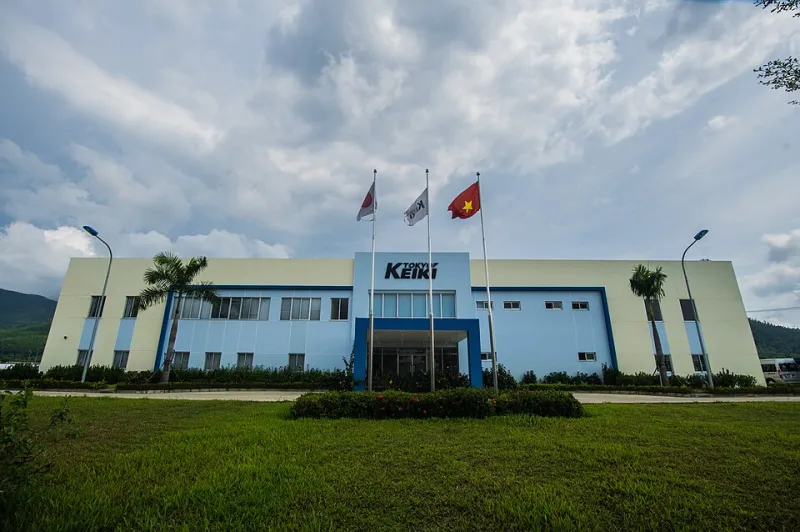
Photo: DHTPMB, CC BY-SA 3.0, via Wikimedia Commons
Walk the floor of any major American manufacturing facility — an automotive plant in Michigan, a semiconductor fabrication line in Arizona, a medical device operation in Minnesota — and you will encounter, embedded in the machinery and the materials, a quiet but pervasive Japanese presence. Specialty steel alloys. Precision bearings. Photolithography equipment. Advanced polymer compounds. Electronic control modules engineered to tolerances that few other producers in the world can match.
This is the hidden architecture of American industrial production: a web of Japanese-sourced components, materials, and manufacturing expertise so deeply integrated into US supply chains that most American executives rarely think about it — until something goes wrong.
Something, increasingly, is going wrong.
The Depth of Dependence
The scale of Japan's embedded role in American manufacturing is frequently underappreciated, in part because it operates below the level of finished goods where trade statistics are most visibly reported. Japan does not primarily sell the United States cars or televisions anymore — those categories have shifted substantially to domestic production, South Korea, and China. What Japan sells, in quantities that dwarf casual understanding, are the specialized intermediate inputs without which American production lines would falter.
Consider the automotive sector. Even as American automakers have diversified their supplier bases over the past two decades, Japanese companies retain dominant or near-dominant positions in categories including advanced high-strength steel, precision transmission components, catalytic converter substrates, and — critically for the electric vehicle transition — specialized battery separator films and electrolyte materials. Companies like Toray Industries, Sumitomo Electric, and Aisin supply components that find their way into vehicles assembled under virtually every major American brand.
The semiconductor industry tells a parallel story. ASML of the Netherlands may manufacture the extreme ultraviolet lithography machines that dominate headlines, but the specialized photoresists, polishing compounds, and silicon wafer blanks that those machines process are disproportionately Japanese in origin. Shin-Etsu Chemical and Sumco together account for the majority of the world's silicon wafer supply. JSR Corporation and Tokyo Ohka Kogyo produce photoresists for which no immediately scalable non-Japanese alternatives exist.
When a fire temporarily disrupted a Renesas Electronics plant in Ibaraki Prefecture in 2021, the ripple effects reached Ford, General Motors, and dozens of other American manufacturers within weeks. That incident offered a rare moment of public visibility into dependencies that normally operate in silence.
Geopolitical Pressure and the Reshoring Imperative
The Biden administration's CHIPS and Science Act, the Inflation Reduction Act's domestic content requirements, and the broader political consensus around reducing strategic supply chain vulnerabilities have introduced new friction into the US-Japan industrial relationship — not because Japan is perceived as an adversary, but because reshoring mandates are, by definition, indifferent to the nationality of the displaced supplier.
Japanese companies that have spent decades building supplier relationships with American manufacturers now find themselves navigating incentive structures that reward localization regardless of where the most sophisticated production expertise resides. The political logic is straightforward: American voters respond to American manufacturing jobs. The economic logic is considerably more complicated.
"There is a tendency in Washington to speak about supply chain resilience as though it is simply a matter of political will," said one trade economist who advises both American corporations and Japanese government ministries. "The reality is that certain capabilities took Japan forty years to develop. You cannot replicate them in Ohio in four years because a subsidy program tells you to."
This tension is not lost on Japanese policymakers or corporate leadership. Several major Japanese manufacturers have responded pragmatically, accelerating investment in US-based production facilities — a strategy that simultaneously satisfies American political requirements and deepens their footprint in the world's largest consumer market. Toyota's battery plant investments in North Carolina and Kentucky, Panasonic's Kansas battery facility, and Denso's expanded US manufacturing operations all reflect this calculus.
The China Variable
Underlying much of the current supply chain anxiety is the shifting geometry of US-China relations, which affects Japan in ways that are simultaneously straightforward and deeply complex. Japan shares American concerns about over-dependence on Chinese manufacturing for sensitive categories — rare earth elements, certain pharmaceutical precursors, advanced electronics. In that sense, Japanese and American strategic interests are substantially aligned.
Yet Japan also maintains a substantial and economically significant trade relationship with China that it cannot simply restructure on a geopolitical timeline. Japanese companies operating in China employ hundreds of thousands of workers and generate revenues that flow back to parent companies whose American operations depend on that corporate health. When American policymakers press Japanese counterparts to decouple more aggressively from Chinese markets and suppliers, the response is frequently cooperative in tone but measured in practice.
For American businesses, this means that the Japan-as-alternative-to-China framing, while partially valid, requires nuance. Japanese companies can and do offer supply chain diversification from Chinese sources in many categories. But they are not, and will not position themselves as, instruments of a zero-sum economic confrontation with Beijing.
What American Companies Must Do Now
For US procurement officers, supply chain managers, and executives with exposure to Japanese suppliers, the current environment demands a more deliberate engagement strategy than most organizations have historically maintained.
First, mapping exercises that identify second and third-tier Japanese supplier dependencies — not just primary vendors — have become essential rather than optional. The Renesas disruption demonstrated that vulnerability often resides not in direct supplier relationships but in the suppliers' suppliers, whose identities American companies frequently do not know.
Second, investment in supplier relationship depth is warranted. Japanese business culture places considerable weight on loyalty and long-term commitment. Companies that maintain active, relationship-oriented engagement with Japanese partners — through regular site visits, joint development programs, and reciprocal transparency about production planning — are consistently better positioned to receive priority allocation during supply crunches than those who treat procurement as a purely transactional function.
Third, American firms should engage actively with the Japan Business Federation and bilateral trade bodies to ensure that reshoring policy frameworks account for the genuine complexity of existing Japanese supply relationships. Blanket domestic content mandates that fail to distinguish between strategic vulnerabilities and productive interdependencies risk generating supply disruptions that serve no one's interests.
A Relationship Worth Protecting
The US-Japan economic relationship, viewed through the lens of supply chains rather than headline trade figures, is more intricate, more mutually dependent, and more strategically significant than the political conversation around it typically acknowledges. Japan is not a passive component supplier — it is an active participant in American industrial capability, a repository of manufacturing knowledge that took generations to accumulate, and a partner whose reliability has been demonstrated across decades of economic turbulence.
The fractures now appearing in this relationship are real, driven by forces — geopolitical competition, domestic political pressures, demographic shifts in Japan's own industrial workforce — that will not resolve themselves. Managing them intelligently requires American businesses and policymakers to engage with Japan not as a taken-for-granted dependency but as a relationship requiring active cultivation.
The shelves will stay stocked, for now. Whether they remain so in the decade ahead depends considerably on choices being made today.